 Iktiup Mahmud
· 5 min read
What competitive programming taught me about backend engineering
After 1000+ problems on Codeforces and other judges, here's what carried over to building real backend systems - and what I had to unlearn.
- #competitive-programming
- #backend
- #algorithms
- #career

I've solved more than a thousand problems across Codeforces and other online judges. People sometimes ask whether that's useful for "real" work, or just a game for interviews.
My honest answer: it's one of the best trainings I've had for backend engineering - as long as you know which habits to keep and which to leave at the contest.
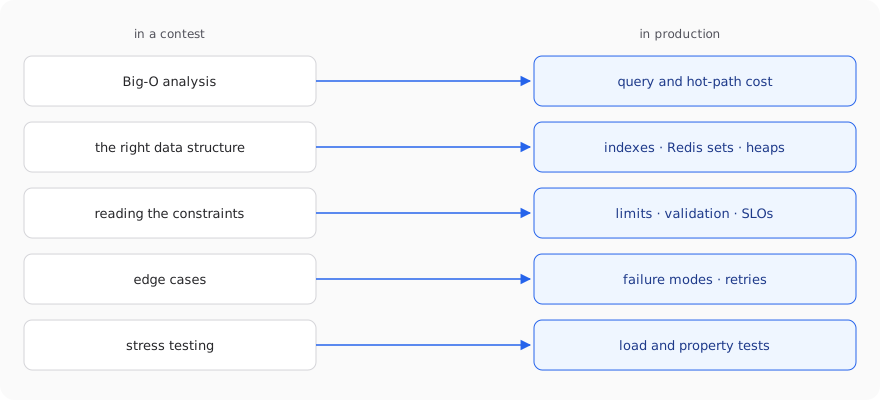 The skills transfer - they just show up in different places
1. Complexity is a production concern
In a contest, an O(n²) solution on n = 200,000 is a guaranteed Time Limit Exceeded. You learn to estimate cost before writing a line of code.
In a backend, that instinct becomes the most valuable code review question I know: "what happens when this list has a million items?"
The classic example is the N+1 query:
// 1 query for orders + 1 query per order = N+1 round trips
const orders = await db.order.findMany({ where: { userId } });
for (const order of orders) {
  order.items = await db.orderItem.findMany({ where: { orderId: order.id } });
}
With 20 orders in development, nobody notices. With 2,000 orders in production, the page takes seconds. The fix is the same thinking as in a contest - reduce the number of expensive operations:
const orders = await db.order.findMany({
  where: { userId },
  include: { items: true }, // one or two queries total, regardless of N
});
The "expensive operation" is no longer a loop iteration. It's a network round trip, a query, a lock or an API call. But the analysis is identical.
2. Choosing the right data structure
Contests drill a reflex: what's the operation I need to make fast? Membership → set. Minimum so far → heap. Rank or range → sorted structure or segment tree.
Backends are full of the same questions, just at a different layer:
- "Is this user online?" → a Redis set, O(1) membership.
- "Top 100 players by score" → a Redis sorted set:
ZADDandZREVRANGEinstead of sorting a table on every request. - "Process the job with the earliest deadline" → a priority queue.
- "Find orders by status and date, fast" → a composite database index, which is just a B-tree you choose to maintain.
Picking the structure first, then writing the code, avoids a lot of rewrites.
3. Reading the constraints
The first thing you learn in competitive programming is to read the constraints before the story. n ≤ 10⁵ tells you the intended complexity. Values up to 10¹⁸ tell you a 32-bit integer will overflow.
The backend version is asking about limits before designing anything:
- How many requests per second, at peak - not on average?
- How large can a payload get? What's the biggest customer's data?
- What latency is acceptable? What's the budget for each dependency inside it?
And then enforcing those limits: validate input sizes, paginate every list endpoint, set timeouts on every outgoing call. A contest problem guarantees its constraints. Production users don't, so you have to.
4. Edge cases are where systems fail
Wrong Answer on test 37 teaches humility. The solution works for normal cases and breaks on an empty array, a single element, or all-equal values.
Production has its own "test 37": the empty cart, the user with no email, the timezone at midnight on the last day of a month, the retry that arrives after the original succeeded, the webhook delivered twice. I now go through edge cases deliberately, the same way I would before submitting:
- Empty, one, many.
- Duplicates - is this operation idempotent if it runs twice?
- Failure halfway - what state is left if the process dies between step 2 and step 3?
- Ordering - what if messages arrive out of order?
5. Stress testing
A contest trick: write a slow, obviously-correct brute force, a random input generator, and compare both solutions on thousands of inputs until they disagree. It finds bugs your own test cases never would.
That idea maps directly to property-based testing. Instead of writing examples, you state a property and let the library generate inputs:
import fc from 'fast-check';

test('applying a discount never produces a negative total', () => {
  fc.assert(
    fc.property(fc.nat(1_000_000), fc.integer({ min: 0, max: 100 }), (cents, percent) => {
      expect(applyDiscount(cents, percent)).toBeGreaterThanOrEqual(0);
    }),
  );
});
And at the system level, the same mindset is load testing: don't guess where the limit is - generate the traffic and find it before your users do.
6. Debugging by bisection
When a solution fails and you don't know why, you binary-search the problem: comment out half, check, repeat. In production, the same idea has names - git bisect to find the commit that introduced a bug, and removing half of the moving parts until the failure disappears. Logarithmic debugging beats staring at code.
What I had to unlearn
Not everything transfers. Some contest habits are actively harmful in a codebase:
- Short, clever code. Variables named
a,b,dpare fine for a 2-hour contest. Code in production is read hundreds of times by other people. Clarity wins over brevity. - Optimizing everything. In a contest, fast code is the goal. In production, most code isn't on a hot path. Measure first, optimize where it matters, and keep the rest simple.
- Solo speed. Contests reward one person working fast. Real systems are built by teams, with reviews, documentation and trade-offs you discuss before coding.
- One correct answer. Contest problems have one. Engineering problems have many acceptable answers with different costs. The skill is choosing, and explaining why.
Is it worth it?
If you're a student wondering whether competitive programming is worth the time: yes, as training - for thinking in costs, choosing data structures, respecting constraints and hunting edge cases. Those habits make you a noticeably better backend engineer.
Just don't stop there. Build real projects, read other people's code, and learn to write for humans as well as for the judge. The combination is where the value is.